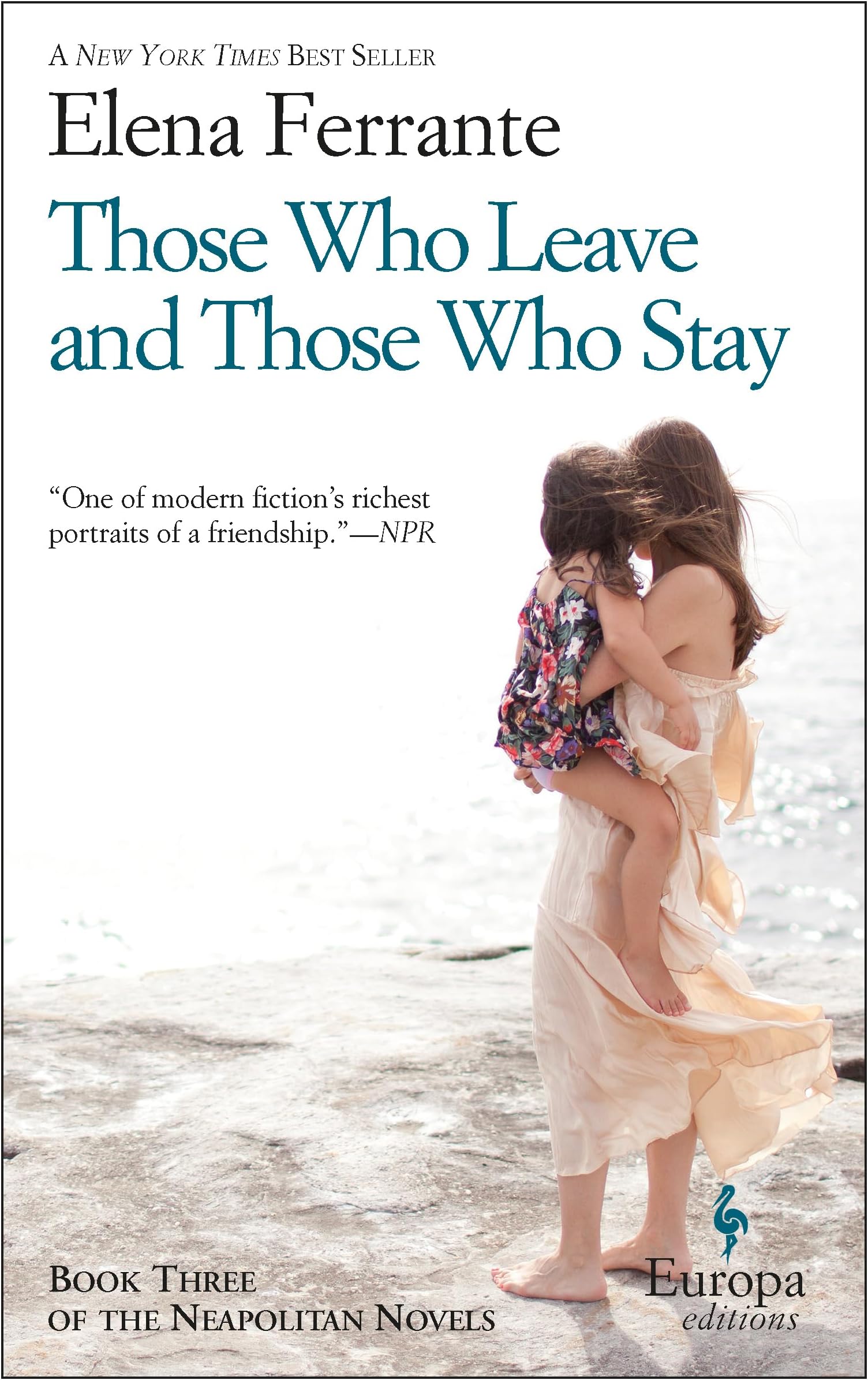
Those Who Leave and Those Who Stay: A Novel (Neapolitan Novels, 3)
Product ID: 5678457
🌍Set in transformative 1970s Italy
📚3rd novel in acclaimed Neapolitan series
👩🎓Themes of female empowerment & education
Desertcart purchases this item on your behalf and handles shipping, customs, and support to Turkey.
📖 Unlock the power of female friendship and fierce ambition in 1970s Italy — don’t miss the saga everyone’s talking about!
Those Who Leave and Those Who Stay is the third novel in Elena Ferrante’s bestselling Neapolitan series, set against the backdrop of 1970s Italy. It chronicles the divergent paths of childhood friends Elena and Lila as they navigate womanhood, societal expectations, and personal ambition. Celebrated for its rich cultural detail and complex character development, this novel is a compelling exploration of friendship, feminism, and social change.


| Best Sellers Rank | #17,005 in Books ( See Top 100 in Books ) #242 in Women's Divorce Fiction #291 in Family Saga Fiction #298 in Friendship Fiction (Books) |
| Customer Reviews | 4.4 out of 5 stars 15,974 Reviews |
C**S
I can't remember when I have been so completely taken with a series of novels as I have been with these beautifully written and
Those Who Leave is the third book in the author's "Neapolitan Novels" (with the fourth, The Story of the Lost Child, scheduled for publication in the U.S. in September 2015) and it is as gripping and enthralling as the first two. The series is set in a somewhat insular neighborhood of Naples. It is now the late 1960s and 1970s and the two main characters, whose friendship constitutes the center of the books, are now somewhat estranged as their lives have grown complicated and divergent. Still living in Naples, Lina has separated from her husband and is raising her young son while Elena has graduated from college and published a novel. But the actually events of the narrative are not the author's primary concern. Rather, it is the internal life of the two characters and how their own idiosyncratic reactions provide a shape to their stories. In addition to drawing complex characters, Ferrante provides a fascinating portrait of the culture of this slice of Italy during rapidly evolving times. Taken together, the novels are both a coming-of-age story and a coming-into-maturity tale of two diverse women who somehow maintain their own complex, and often convoluted, relationship. I can't remember when I have been so completely taken with a series of novels as I have been with these beautifully written and deeply realized stories, and I am having trouble waiting for the final volume. I recommend Those Who Leave and the two previous books in the series with absolutely no reservations.
M**J
no payday of an ending but a nice reading experience
Once, when I was a teenager back in the good old 1990's, I was reading Seventeen Magazine and came across a candy-bar ad. The ad was a picture of the candy-bar, and the slogan that it was "totally nuts." In the background there was a lot of text in very fine print. I started reading this text, which was a parody version of a 90's teenage girl rambling on forever about nothing. Phone conversations, clothing descriptions, the word "like" thrown in every tenth word or so. Yet I kept reading the whole thing. I was mesmerized and oddly soothed by the repetitive nothingness of the "story." And then, over halfway through, the story was interrupted by congratulations for making it through such a "nutty" story and offered me a free teeshirt. What does this have to do with Elena Ferrante's novel? The repetitive, almost nothingness of the story through the first three books had a similar feeling for me, and I found myself remembering that ad for the first time in many years. Much as I was compelled to finish the advertisement, I also could not put these books down, and I have now finished the 4th novel. This being said, I do not know if I can honestly describe them as being great storytelling. The protagonist (Lenù) is unlikable and rather selfish and short-sighted. She has enough intelligence to excel in school with a lot of hard work, but she never exhibits her own opinion and keeps trying to act in a way that people will reward with praise rather than have any ideas or presence of her own. But yet she is sympathetic at times as someone trying to be her best self, using education as the means. Lila, the friend, is fascinating, but remains a bit of an enigma throughout the books. I wished many times that we were reading the story from her perspective. But I did read it all, and the two women characters do grow up and hit milestones of life throughout the books, but the pattern that they go through remains the same always as they age. Definitely worth reading if you are a reader of novels. A well written, and a unique kind of story for sure, but kind of like reading a teenage girl's long ramble of her inner consciousness that she is aware someone is going to read one day. But the novel does provide plenty of deeper themes to think about and ponder. Feminism, poverty, the modern era and how it changed society, and yet how things stay the same too. The mid-century Italian setting was interesting and was a great atmosphere to the novels. Perhaps if a free tee-shirt had been offered in the middle of the book, it would have gotten 5 stars from me, but alas that was not the case.
A**R
you can't quite figure out why you like it so much
In book one you realize Elena Ferrante is a powerful storyteller with an authentic female voice; something nags at you, you can't quite figure out why you like it so much. Maybe because is seems so personal and brave-- she talks about the things we hide in ourselves. In book two, there is a certain point where you realize how brilliant she is and how subtle and layered that brilliance is; it shines new light on book one. In this book, book three (yes read them all and read in order to see the way she evolves her writing) there is a point where I actually laughed with delight to discover something new about her characters and her writing-- a layer of metaphor and universal pull that further underscored the intelligence she is so comfortable with she never has to let it dominate. Only the story, the characters, the sweep of human emotion dominate is such a gentle way that you find yourself suddenly crying or in awe or gasping-- and you have no idea why, all she is just slowly finds it's way into your soul. When I hear there's a book that a lot of women love, that's sweep the country in sales just on word of mouth, I generally run in the other direction. But when I saw the fourth book on the NYT ten top books of the year, I had to reconsider and am so glad I did. Yes it is a book women will especially love but not because it is light and silly and romantic-- because it is harsh and beautiful and brings life into a city and a friendship in a way we all understand but have never heard expressed in such a bold and completely vulnerable way.
A**R
Very good series HIGHLY recommend
The Neopolitan series is my favorite book series i love it so much. so good about female friendship, growing up in poverty and patriarchy, misogyny… SO GOOD
S**E
Will education or marriage be the magic opportunity to be different from their mothers?
Ferrante's experimental fiction, where two friends are entwined from early childhood, plays around myths - the myths of origin, Dido, Pinocchio and others. The two friends are mirrors to each other, each taking turns to play good fairy/bad fairy. Lila writes a story "The Blue Fairy" that weaves the myth in and out of the quartet. Ferrante works with identity and self. Can one be truly creative alone, or is it a combined effort of shared genius that produces art? Do we all steal ideas all the time, do we merge, mingle, remake originality? Both Lila and Elena reach out of poverty to become "real" women. Will education or marriage be the magic opportunity to be different from their mothers? Lila gives up on education and holds out for love, but when she finds herself abandoned by her lover, she burns the copy of the myth she wrote for herself. Elena chooses education but then finds herself, in spite of marrying well, in the same predicament as her mother. In this third book, Elena finds she's stuck at home, enslaved to it, to her children and a husband who is himself trapped in an ivory tower. She struggles with the notions of beauty, sexuality, being attractive to men, or just being comfortable with herself. Both women long to be more than an automaton - a creation of male ideas. I enjoyed the feminist text, the social, political discourse, but in the end the story, with its intertextuality, is just brilliant.
P**N
Those Who Leave and Those Who Stay by Elena Ferrante: A review
"Each of us narrates our life as it suits us." - Lila Cerullo in Those Who Leave and Those Who Stay This is the third in Elena Ferrante's acclaimed Neapolitan Quartet of novels which chronicle the lifelong friendship of Lila and Elena. In this one, the women have reached their mid-twenties and we follow them to their early thirties. The time is 1969 to the mid-'70s. I think it would be a huge mistake to try to read any one of these novels as a stand-alone or to read them out of order. Each one builds on the previous book(s) and each is a continuation of that narration of two lives. Here we find that Lila, having left the comforts or at least the prestige offered by her marriage to the businessman Stefano, is working at a sausage factory and living, along with her young son, with her childhood friend Enzo who is in love with her. They maintain a platonic relationship. Lila is overworked and stressed out, struggling to survive financially, emotionally, and intellectually. The brilliant child that she had been had been forced to leave school early and chose marriage as her escape. When that didn't work out, she left the marriage and is now trying to make it on her own. That isn't working so well either. Elena, of course, has been luckier. She received lots of help and support from teachers and others who believed in her along the way and she was able to complete college and write a novel that proved very successful. It was a novel that shocked many in her old neighborhood with its frank discussion of sexual relationships. At the beginning of this book, she is engaged to be married to a brilliant young professor from an upper class family, a man who is her intellectual equal. The book follows their first few years of marriage and the births of their two daughters. As a wife and new mother, Elena, too, is harassed and stressed out by her marital and parental responsibilities, unable to write. She is miserable. All around the women and their families, Italy and Europe and, indeed, the Western world are exploding in the late '60s and '70s with political and social unrest. Their old neighborhood of Naples is becoming even more violent and childhood friends are involved in the labor movement and the violent clashes between communists and fascists. Some of them lose their lives in the violence. Meanwhile, Elena is on the sidelines and seeking a way in and a way to write about what is happening. She becomes interested in the feminist movement and, in her own way, pulls Lila along. In this book, the women's friendship is sorely tested time and again. But at the lowest point in Lila's life, the person she asks for is Elena and when Elena comes and sees the state she is in, she resolves to help her, even though at times she hates her and wishes her dead. Through her efforts, Lila and Enzo are able to get better jobs and to improve their condition. But Elena still is suffering a drought in her writing career. So many events from the girls' childhood and their earlier lives come back to play pivotal points in this story - which is why it is so important to read the books in order. That time that Lila designed a shoe in book one comes back to be talked about and to play a part in book three. The day that Elena and Lila skipped school and walked as far away from the neighborhood as they could - it was Lila who finally wanted to turn back; or when Lila held a knife to a man's throat to protect herself and Elena; all of these prior events are still a part of the narrative. Ferrante seems to say that it is from such events that may have seemed rather insignificant at the time that the fabric of female friendship is woven. It is not at all a simple or smooth fabric. It is bumpy with every human emotion including such negative ones as fear, rage, and jealousy. But there is also respect and the unbreakable thread of shared experiences that keeps it all together. These novels are so extraordinary for showing the choices that Elena and Lila are forced to make as they attempt to escape the poverty and violence of their neighborhood. And this particular novel shows how some of those choices that may have seemed right at the time turned out to be serious mistakes. Elena, for example, for all of her laudable attempts to help Lila, makes some personal choices here that cast her in a very bad light and that I suspect will prove, in the fourth book, to be a source of regret. But for that we'll have to wait and see, won't we?
T**A
How do such intelligent women make such poor choices in life?
I did not think Volume Three of this extraordinary soon to be tetralogy was up to the standards of the first two books. Then again, perhaps I am just getting tired, as I have read all three over the last few weeks. As that fact indicates, I did find the work gripping, and Volume Three was no different at least through the middle of the book. As usual, the emotional link between the two women, now in their twenties and early thirties is intense, and vividly rendered. Beyond that, the depiction of the union organizing and fascist and anti-fascist strife was done very well. I have read little like it. Nevertheless, for me this whole series has major flaws. While it is very upscale chick lit and an entertaining read, perhaps the stuff of a major television mini-series, this is not great literature. There is far too much dependence on mindless coincidence. Simlarly, the introduction of Elena's younger sister Elisa as an important character late in the book, without any preparation is a major flaw. As usual, for the most part, the minor characters are only lightly drawn and are virtually indistinguishable. But it is the major characters who gave me most pause. Lila becomes in this volume nearly a character out of science fiction. She has almost superhuman powers. She is prescient, beautiful, and every man falls ineluctably in love with/lusts after her. It is too much. Similarly, after three volumes and 1200 pages, it is clear that Elena is stuck on the womanizer Nino, but I defy anyone to tell me why. There is no basis for it outside of Elena's psyche, and she is not sharing that with us. The action is melodramatic, operatic. The attempts at explanation of the ladies' feelings are sophistical. We never really know what Lila and Elena are thinking. They switch at a moment's notice and there is never any real explanation for the changes. Each of them lacks an observing ego--something characters always exhibit in the best art--getting to the heart of what makes them tick. After all this sturm and drang, Elena still doesn't know herself and is still almost totally dependent on others to get along in life. I won't spoil the end of the book except to say that to me it was morally and psychologically disappointing in the extreme. I would say more except that the last page prompts me to predict that Elena will have yet another reversal of fortune early in Volume 4 (which I will read). Lila does not know herself either, and her turning into a computer wizard after being a journeywoman sausage stuffer strains one's credulity. Finally and unfortunately, like so many other characters in modern fiction and in life, the two are driven by needs for sex, money and social status, not by love. This work is less than the sum of its parts.
M**S
Why!!
Lenù!!! Why?!! Dang it! Spoiler:: Why would you leave your life...your children and husband for Nino?! I don't even know if I can finish this dang series because I'm so mad at Elena!
M**O
女性の人生
イタリアナポリで生きる女性達の人生をしばし共有。強く共感させる筆致で、読書の幸せを感じてます。
C**E
bello
Non e un libro facile a capire, pero ha la capacita di farti riffletere, di cercare delle informazioni, di scopriti a te stesso.
D**A
story of what remains behind when you leave
Story of staying and leaving and what we consider more important when we have a whole family to leave behind. Which act is exactly called selfish? Will a mother be called selfish if she acts for her happiness or eventually everything can be reasoned with unhappiness in the present situation? This and many more themes underlying this book.
M**A
quatro livros excelentes
não é um thriller de ação, mas a história toca pelo realismo e profundidade emotiva
T**F
Superb
I have read all 4 of Elena Ferrante`s Neapolitan novels and found them well-written, with very interesting plots and interacting of characters and the influence their childhoods had had on them. I believe I have never read an author who did such a fantastic job, working in psychological studies as well as connecting the story to historical events of the various time periods. In addition, she writes very well. Loved all 4. I did find it rather difficult to retain in my head who was who, since there are a lot of characters; however, Ferrante does make a list of them at the beginning of each book and reviews what has taken place in the story up to that point.
Trustpilot
3 weeks ago
5 days ago